

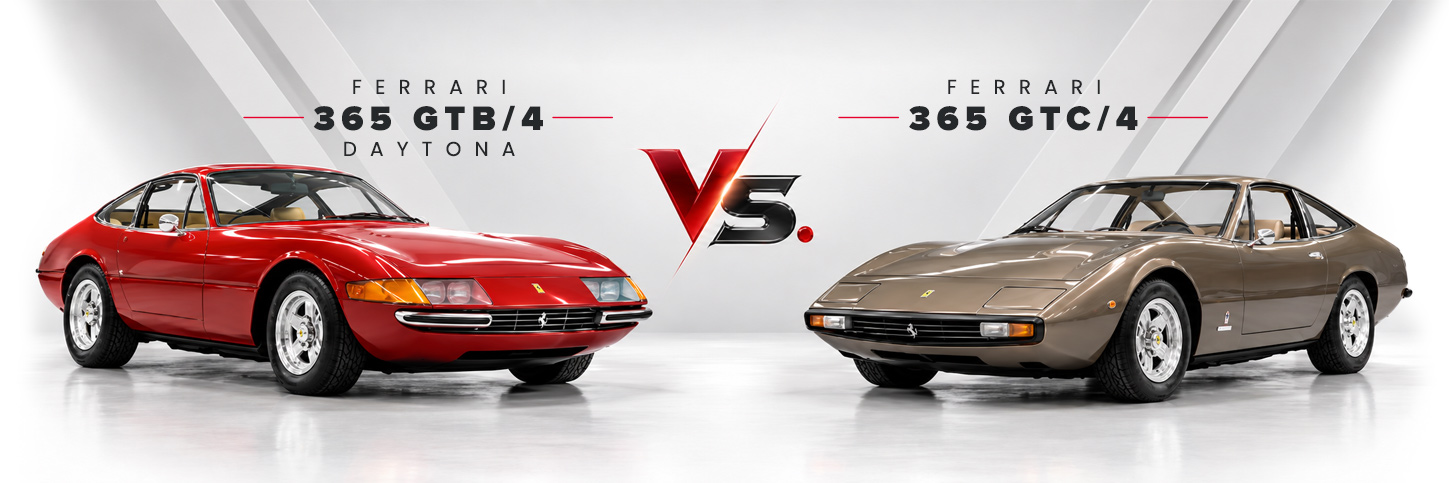
Ferrari 365 GTB/4 Daytona vs. Ferrari 365 GTC/4
The Ferrari 365 GTB/4 vs. Ferrari 365 GTC/4 comparison brings together two distinctive grand tourers from Ferrari’s hand-built era, each offering a different interpretation of the front-engine V12 formula. Although both models feature a 4.4-liter Colombo V12, their design, performance, and driving characteristics reflect different priorities. Introduced in 1968, the 365 GTB/4 Daytona was Ferrari’s flagship two-seat berlinetta, combining exceptional high-speed performance with aggressive Pininfarina styling. The 365 GTC/4, introduced in 1971, offered a more refined approach to grand touring, with 2+2 seating, greater passenger comfort, and a more accommodating driving experience. Beyond their differences in performance and design, the two models present distinct considerations for maintenance, everyday usability, and collector market value. Understanding these differences can help prospective buyers determine which Ferrari 365 better suits their driving preferences, ownership expectations, and collecting interests.
Ferrari 365 GTB/4 Daytona vs. Ferrari 365 GTC/4: Key Differences
The primary difference between the Ferrari 365 GTB/4 Daytona and the Ferrari 365 GTC/4 lies in their intended purpose. The Daytona is a performance-focused, two-seat grand tourer designed for high-speed driving and a more sporting experience, while the GTC/4 emphasizes refinement, comfort, and long-distance touring with occasional rear seating. Although both models use a 4.4-liter Colombo V12 and share Ferrari’s front-engine grand touring heritage, their engine configurations, transmissions, suspension tuning, and interior layouts create distinctly different driving experiences.
| Feature | Ferrari 365 GTB/4 Daytona | Ferrari 365 GTC/4 |
|---|---|---|
| Production years | 1968–1973 | 1971–1972 |
| Engine | 4.4L Colombo V12 | 4.4L Colombo V12 |
| Seating | 2 | 2+2 |
| Transmission | 5-speed manual, rear transaxle | 5-speed manual |
| Driving focus | High-performance grand touring | Comfortable grand touring |
| Steering | Unassisted | Power-assisted |
| Collector positioning | Iconic, highly sought-after | More accessible classic V12 GT |
| Best suited for | Performance-focused collectors | Touring-focused enthusiasts |
Interested in buying a Ferrari 365 GTB/4 Daytona? Check out our Ferrari 365 GTB/4 Daytona Buyer’s Guide for more information.
Ferrari 365 GTB/4 Daytona vs. Ferrari 365 GTC/4: Design and Styling
The Ferrari 365 GTB/4 Daytona and Ferrari 365 GTC/4 were both styled by Pininfarina, sharing the long hoods, low profiles, and elegant proportions characteristic of Ferrari’s front-engine V12 grand tourers. However, their designs reflect different approaches to performance and luxury. The Daytona features a more aggressive, purposeful two-seat berlinetta design, while the GTC/4 adopts a more understated fastback profile that accommodates occasional rear passengers without sacrificing its sporting proportions.
Ferrari 365 GTB/4 Daytona Design and Styling
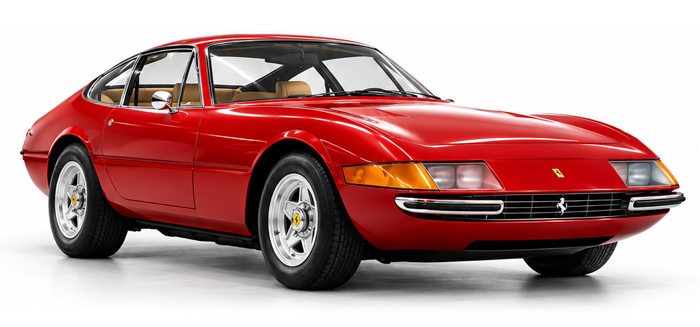
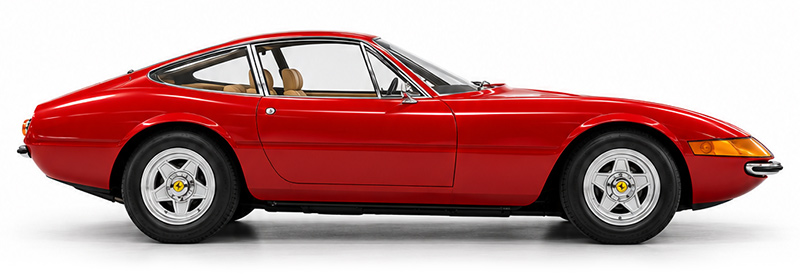 Designed by Leonardo Fioravanti at Pininfarina, the 365 GTB/4 Daytona introduced a sharper, more angular appearance than its predecessor, the 275 GTB/4. Its elongated hood, steeply raked windshield, compact passenger compartment, and muscular rear haunches create a distinctive silhouette that has become one of Ferrari’s most recognizable classic designs. Early Daytonas featured fixed headlights beneath a full-width Plexiglas panel, while later examples adopted retractable headlights to comply with changing regulations. The Daytona’s relatively short cabin, low roofline, and truncated rear emphasize its performance-oriented character.
Ferrari 365 GTC/4 Design and Styling
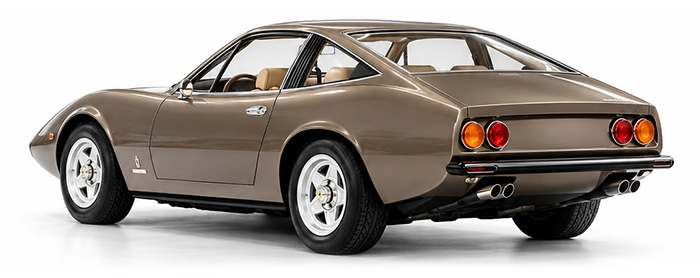
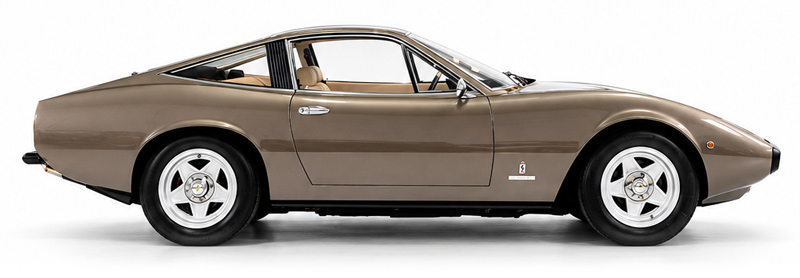 The 365 GTC/4 takes a different approach, combining a long, low hood with a more flowing roofline and extended fastback rear. Its lower hood profile was made possible partly by the use of sidedraft Weber carburetors, distinguishing it from the Daytona’s taller engine arrangement. Retractable headlights, a distinctive black polyurethane front bumper surrounding the grille, and a black rear panel give the GTC/4 a more contemporary appearance for the early 1970s. Its longer passenger compartment and sloping rear glass provide space for occasional rear seating and luggage, making the design better suited to extended grand touring.
Viewed together, the two models demonstrate how Pininfarina adapted Ferrari’s traditional front-engine proportions to different purposes. The Daytona’s compact cabin, pronounced hood, and assertive rear profile communicate its emphasis on high-speed performance, while the GTC/4’s smoother lines, more accommodating cabin, and restrained exterior details reflect its focus on comfortable long-distance travel. Neither design represents a compromise of the other. Instead, each expresses a distinct interpretation of Ferrari’s V12 grand touring philosophy.
Ferrari 365 GTB/4 Daytona vs. Ferrari 365 GTC/4: Engine and Performance
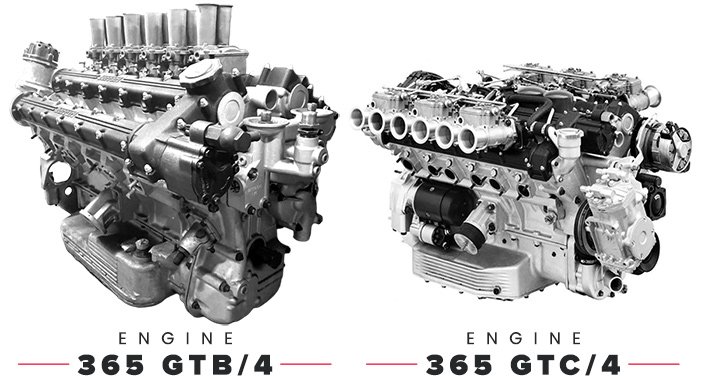
The Ferrari 365 GTB/4 Daytona and Ferrari 365 GTC/4 share a 4.4-liter Colombo-derived V12 with four overhead camshafts, but their engine configurations and mechanical layouts reflect different performance priorities. The Daytona’s 4,390 cc V12 produces approximately 352 horsepower at 7,500 rpm in European specification, compared with 340 horsepower at 6,200 rpm for the European-specification GTC/4. U.S.-market GTC/4 models are commonly quoted at approximately 320 horsepower, although published figures vary depending on the source and measurement standard. Despite their relatively modest difference in peak output, the two engines deliver power differently, with the Daytona emphasizing high-rpm performance and the GTC/4 offering a more flexible character suited to long-distance touring.
Engine
The Daytona uses six downdraft Weber carburetors and a dry-sump lubrication system, reflecting its more sporting engineering. The GTC/4 employs six sidedraft Weber carburetors, revised cylinder heads, a lower compression ratio, and conventional wet-sump lubrication. Its sidedraft arrangement also allows the engine to sit beneath a lower hood line. Both European-specification engines are commonly quoted at approximately 318 lb-ft of torque, although the Daytona develops its peak at around 5,500 rpm compared with approximately 4,000 rpm for the GTC/4. This difference helps explain the GTC/4’s more accessible power delivery at moderate engine speeds.
The transmission layout creates another important distinction. The Daytona features a rear-mounted five-speed manual transaxle, helping distribute weight between the front and rear axles and contributing to its sporting handling characteristics. The GTC/4 uses a five-speed manual transmission mounted directly behind the engine, transmitting power to the rear differential through a conventional driveshaft arrangement. Combined with its different gearing, greater weight, and comfort-oriented suspension tuning, this arrangement gives the GTC/4 a more relaxed grand touring character without sacrificing the responsiveness expected of a Ferrari V12.
Performance
Factory performance figures further illustrate the distinction. The Daytona has a quoted top speed of approximately 174 mph (280 km/h), compared with 162 mph (260 km/h) for the GTC/4, giving the Daytona an advantage of approximately 12 mph. The Daytona also delivers stronger acceleration, although published 0–60 mph times vary depending on vehicle specification, testing conditions, and measurement methods. While the Daytona offers greater outright performance, the GTC/4 remains a genuinely high-performance Ferrari, combining substantial V12 power with a more accommodating driving experience.
Ferrari 365 GTB/4 Daytona vs. Ferrari 365 GTC/4: Driving Experience
The Ferrari 365 GTB/4 Daytona and Ferrari 365 GTC/4 offer distinctly different driving experiences despite their shared front-engine V12 heritage. The Daytona is a more physical, demanding grand tourer that rewards driver involvement, while the GTC/4 delivers a more relaxed experience without sacrificing the performance and character expected of a classic Ferrari. Both were designed for covering long distances at speed, but the effort required to drive them and the feedback they provide are noticeably different.
Steering
One of the most significant differences is steering. The Daytona’s unassisted steering is particularly heavy at parking speeds and during slow maneuvers, requiring considerable physical effort. As speed increases, the steering becomes more responsive and communicative, providing direct feedback about the road surface and front tires. The GTC/4’s standard power-assisted steering substantially reduces effort, making the car easier to maneuver in traffic, around town, and on winding roads. Although its steering generally provides less direct feedback than the Daytona’s, the lighter effort contributes to a more comfortable driving experience.
Clutch and Transmission
The differences extend to the clutch and transmission. The Daytona’s relatively heavy clutch and rear-mounted five-speed transaxle demand a deliberate approach, particularly before the gearbox reaches operating temperature. Its traditional dogleg shift pattern requires familiarity, and gear changes can feel resistant when cold. The GTC/4 features a lighter clutch and a conventional H-pattern five-speed gearbox mounted behind the engine, making shifting generally easier and more intuitive. Both transmissions benefit from proper warm-up, but the GTC/4 requires less effort during frequent gear changes and stop-and-go driving.
Suspension Tuning
Suspension tuning further distinguishes the two models. Both use independent suspension with double wishbones, but the Daytona’s firmer setup and rear transaxle contribute to its more sporting handling characteristics. The GTC/4 features softer suspension tuning and was originally equipped with a self-leveling rear suspension system designed to maintain ride height under varying loads. This arrangement helps provide a more composed ride over uneven surfaces, although many surviving GTC/4s have had their original self-leveling components replaced with conventional shock absorbers. Such modifications can affect ride quality and handling, making the condition and configuration of an individual car important considerations.
Driving Experience by Road Type
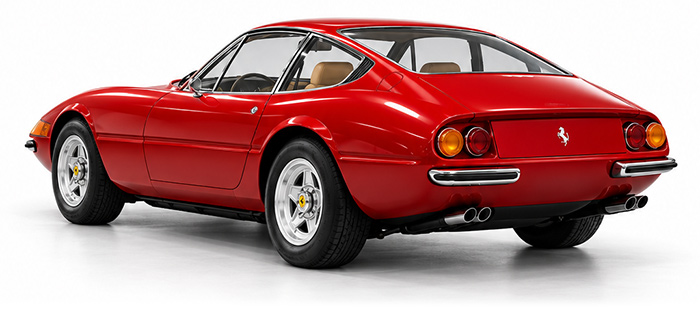 On winding roads, the Daytona rewards a committed driver with greater steering feedback, precise responses, and a stronger sense of connection to the car’s mechanical operation. Its substantial steering and clutch effort can make slower sections demanding, but the car becomes more rewarding as speeds increase. The GTC/4 feels less physically demanding and more forgiving, with lighter controls and a suspension better suited to absorbing road imperfections. Its additional weight and longer wheelbase give it a different character through tighter corners, although it remains a capable and responsive grand tourer.
On highways and extended journeys, both Ferraris demonstrate the strengths of their V12 engines, but the GTC/4 offers a more accommodating environment for regular use. Its lighter controls, more compliant ride, and greater cabin space make longer drives less tiring, particularly when traffic or frequent stops are involved. The Daytona remains an exceptional high-speed touring car, but its more demanding controls and sporting character require greater driver commitment. For enthusiasts seeking a highly involved classic Ferrari, the Daytona offers a more engaging experience. For those who prioritize V12 performance alongside comfort and more frequent use, the GTC/4 presents a compelling alternative.
Ferrari 365 GTB/4 Daytona vs. Ferrari 365 GTC/4: Interior, Comfort, and Practicality
The Ferrari 365 GTB/4 Daytona and Ferrari 365 GTC/4 offer different approaches to interior design and passenger comfort. The Daytona features a traditional two-seat berlinetta cabin that prioritizes the driver and front passenger, while the GTC/4 introduces a more accommodating 2+2 layout with additional interior space and greater luggage flexibility. Although neither was designed as an everyday family car, the GTC/4 provides several practical advantages for owners who intend to drive their Ferrari regularly.
Interior
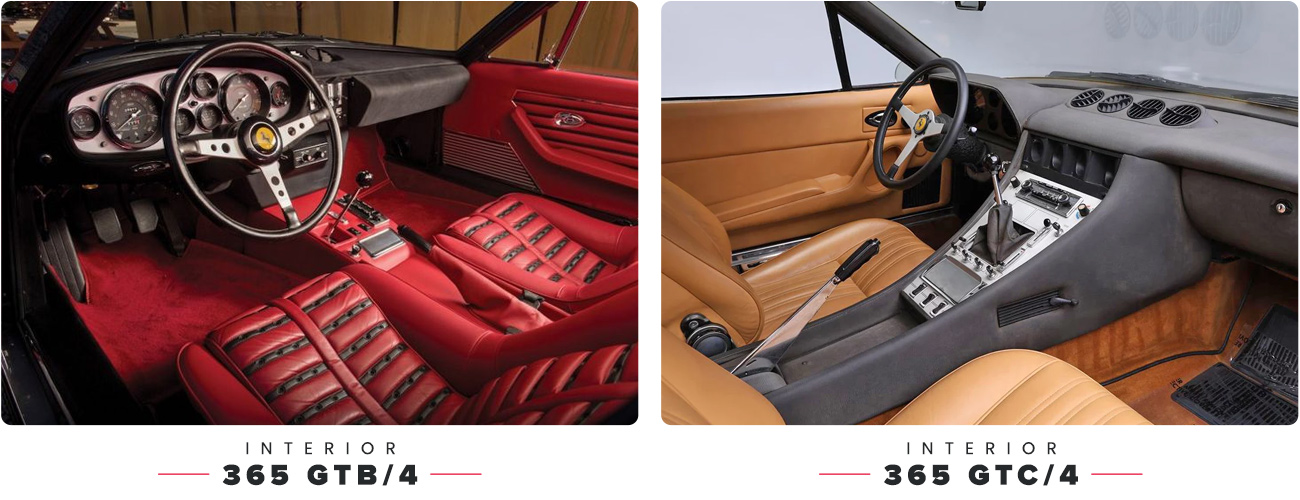
Inside the Daytona, the low seating position, supportive bucket seats, and driver-focused dashboard create a distinctly sporting environment. Its traditional Veglia instrumentation, gated manual shifter, and large steering wheel reflect Ferrari’s performance-oriented design philosophy of the late 1960s. The relatively compact cabin places the driver close to the car’s mechanical operation, while the long hood and low seating position require some familiarity when maneuvering in confined spaces. The GTC/4 features a more contemporary dashboard, a higher seating position, and a wider center console housing the transmission tunnel. Its more upright driving position and lighter controls contribute to a less demanding experience, although the broad transmission tunnel can limit lateral cabin space.
The GTC/4’s most obvious practical advantage is its rear seating. While technically configured for four occupants, the rear seats provide limited legroom and headroom, making them better suited to children, occasional short journeys, or additional luggage rather than regular adult passengers. The folding rear seatbacks also create a useful storage area for bags and personal belongings. The Daytona offers a parcel shelf behind its two front seats and a separate luggage compartment, providing sufficient space for weekend travel but less flexibility when carrying additional passengers or bulky items.
Comfort
Comfort equipment further distinguishes the two models. The GTC/4 was equipped with standard air conditioning, power-assisted steering, and electric windows, reflecting Ferrari’s intention to create a more refined grand tourer. Its original interior typically combined leather bolsters with cloth seat inserts, while full leather upholstery was available as an option. The Daytona also featured electric windows as standard equipment, but air conditioning was optional, and power steering was not offered as a factory feature. As a result, the equipment and comfort levels of individual Daytonas can vary depending on their original specification and subsequent modifications.
Practicality
Both models are capable of extended highway travel, but the GTC/4 is generally better suited to frequent use. Its more compliant suspension, lighter steering, comfortable cruising characteristics, and additional luggage space make weekend trips and longer journeys easier to accommodate. The Daytona remains a capable long-distance grand tourer, with supportive seating and impressive high-speed stability, but its heavier controls and more focused cabin require greater driver commitment. For collectors who prioritize the traditional two-seat Ferrari experience, the Daytona offers a more sporting environment. Owners seeking a classic V12 Ferrari that can be enjoyed regularly, particularly on extended trips, may find the GTC/4’s combination of comfort and practicality more appealing.
Ferrari 365 GTB/4 Daytona vs. Ferrari 365 GTC/4: Reliability and Maintenance Costs
The Ferrari 365 GTB/4 Daytona and Ferrari 365 GTC/4 are mechanically sophisticated grand tourers that require regular preventative maintenance and experienced classic Ferrari specialists. Both use carbureted, four-cam Colombo V12 engines that can provide reliable performance when properly maintained, but their age, mechanical complexity, and specialized components make ownership considerably different from that of a modern Ferrari. Maintenance expenses depend heavily on the condition of the individual car, the quality of previous restoration work, and whether significant mechanical issues have been addressed or deferred.
Ferrari 365 GTB/4 Daytona Maintenance
Both engines require careful attention to carburetor synchronization, ignition timing, valve clearances, lubrication, and cooling system condition. The Daytona’s six downdraft Weber carburetors and dry-sump lubrication system introduce specific servicing requirements, including proper oil-level checks and inspection of the external oil lines and associated components. Its rear-mounted five-speed transaxle also requires attention to gearbox condition, lubrication, and shifting characteristics, particularly when cold. Clutch wear, hydraulic operation, and cooling system performance are additional considerations, especially on cars that have experienced extended periods of storage or inconsistent maintenance.
Ferrari 365 GTC/4 Maintenance
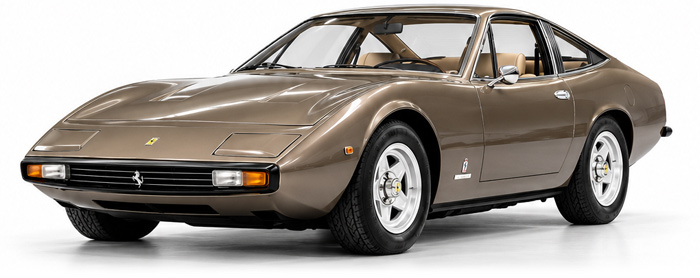 The GTC/4’s six sidedraft Weber carburetors present different access and adjustment considerations, while its conventional wet-sump lubrication system is mechanically simpler than the Daytona’s dry-sump arrangement. However, the GTC/4 introduces additional systems that require attention. Its original hydraulic self-leveling rear suspension can be expensive to repair or restore when components deteriorate, and some examples have been converted to conventional shock absorbers. Power steering components, air conditioning, electric windows, and other electrical equipment also add potential maintenance requirements. Buyers should verify whether these systems remain in their original configuration and operate correctly rather than assuming that all surviving examples have identical equipment.
Corrosion
Corrosion is a significant concern for both models, particularly around structural sections, floor panels, wheel arches, sills, and areas where moisture can accumulate. Aging rubber seals, suspension bushings, brake hoses, fuel lines, and other deteriorating components can also create problems even on cars with relatively low mileage. Fuel tanks, carburetors, cooling passages, radiators, and electrical connections deserve particular attention after prolonged storage. A comprehensive pre-purchase inspection should assess the body and chassis alongside the mechanical systems, as hidden corrosion or poorly executed previous repairs can be considerably more expensive to address than routine servicing.
Parts and Labor
Parts availability and specialist labor also influence ownership expenses. While many mechanical components can be serviced or rebuilt by experienced Ferrari specialists, certain model-specific trim pieces, body panels, suspension components, and original equipment may be difficult to source. The Daytona’s higher collector value does not automatically mean every maintenance procedure costs more, just as the GTC/4’s lower market value does not guarantee inexpensive ownership. Routine maintenance, major mechanical repairs, and comprehensive restoration represent very different levels of expense, with engine rebuilds, corrosion repairs, and extensive bodywork potentially requiring substantial investment.
Ultimately, the maintenance history and condition of an individual Ferrari 365 are more important than the model designation alone. A well-maintained GTC/4 with documented servicing may present fewer immediate ownership concerns than a neglected Daytona, while a properly restored Daytona can be more dependable than a GTC/4 with unresolved mechanical or electrical problems. For either model, detailed service records, evidence of preventative maintenance, and an inspection by a specialist familiar with the specific car are essential to understanding potential ownership costs.
Ferrari 365 GTB/4 Daytona vs. Ferrari 365 GTC/4: Rarity, Market Value, and Collector Appeal
The Ferrari 365 GTB/4 Daytona and Ferrari 365 GTC/4 occupy different positions within the classic Ferrari collector market. Approximately 1,284 Daytona berlinettas were produced between 1968 and 1973, compared with just 505 examples of the GTC/4 between 1971 and 1972. Despite the GTC/4’s substantially lower production volume, the Daytona generally commands significantly higher market values. This difference demonstrates that rarity alone does not determine collector desirability, particularly when comparing Ferrari models developed for different purposes.
Market Value
The Daytona’s stronger market position reflects its historical significance, distinctive Pininfarina styling, and reputation as one of Ferrari’s most celebrated front-engine V12 berlinettas. Its performance capabilities, recognizable design, and association with Ferrari’s traditional two-seat grand touring formula have contributed to sustained collector interest. The GTC/4, by comparison, was developed as a more refined 2+2 grand tourer, prioritizing comfort and usability alongside V12 performance. Although produced in smaller numbers, its less overtly sporting character has historically attracted a narrower collector audience.
Recent auction results illustrate the difference in market valuations. In April 2026, a 1972 Ferrari 365 GTB/4 Daytona sold for €545,000 at RM Sotheby’s Monaco auction. By comparison, a 1972 Ferrari 365 GTC/4 sold for $174,720 at Bonhams in August 2026, while a 1973 GTC/4 achieved $156,800 at RM Sotheby’s Miami auction in February 2026. These results reflect individual completed transactions rather than advertised asking prices, which may not represent what buyers ultimately pay. Because the sales occurred in different currencies and involved cars with potentially different specifications, conditions, and histories, they should be viewed as illustrative examples rather than direct comparisons of equivalent vehicles.
For both models, originality, matching numbers, factory specification, provenance, and restoration quality can substantially influence individual valuations. A Daytona retaining its original engine and gearbox, supported by comprehensive documentation and a high-quality restoration or exceptional preservation, may command a premium over an otherwise comparable example with unresolved historical or mechanical questions. The same considerations apply to the GTC/4, particularly given the importance of original interior materials, factory equipment, and properly functioning mechanical systems. Unusual factory colors, documented ownership history, and Ferrari Classiche certification may also contribute to desirability, although their effect on value depends on the individual chassis and prevailing buyer demand.
Collector Appeal
The GTC/4’s comparatively lower purchase price makes it an appealing option for collectors seeking a classic four-cam Ferrari V12 without the substantially higher acquisition cost associated with the Daytona. Its limited production, distinctive styling, and comfortable grand touring character offer a different ownership proposition rather than simply a less expensive alternative. However, lower market values do not necessarily translate into proportionately lower restoration or maintenance expenses, making mechanical condition and documented upkeep especially important.
The Daytona appeals to collectors who value its historical significance, sporting performance, and traditional two-seat Ferrari character. The GTC/4 offers a different ownership experience, combining lower production numbers with greater comfort, practicality, and a more accessible purchase price. While both models have established places within Ferrari’s V12 heritage, their collector markets reflect different priorities. Buyers should consider the condition, originality, provenance, and maintenance history of individual examples alongside their intended use, rather than relying on rarity or market value alone.
Ferrari 365 GTB/4 Daytona vs. Ferrari 365 GTC/4: Which Should You Buy?
Choosing between the Ferrari 365 GTB/4 Daytona and Ferrari 365 GTC/4 depends on how you intend to enjoy your classic Ferrari. Both offer the distinctive performance and mechanical character of Ferrari’s four-cam V12 engines, but their differences in driving dynamics, comfort, practicality, and collector appeal make them suited to different ownership priorities. The Daytona emphasizes performance and driver involvement, while the GTC/4 offers a more refined approach to grand touring.
Who Should Buy the Ferrari 365 GTB/4 Daytona?
The Ferrari 365 GTB/4 Daytona is particularly well suited to enthusiasts who prioritize performance, driver engagement, and iconic Ferrari styling. Its powerful V12, rear-mounted five-speed transaxle, and unassisted steering create a more physical driving experience that rewards driver involvement. The Daytona’s distinctive Pininfarina design and reputation as one of Ferrari’s most celebrated front-engine berlinettas also make it appealing to collectors seeking a historically significant and widely recognized classic Ferrari.
Buyers should appreciate the Daytona’s traditional two-seat configuration and be comfortable with its demanding low-speed steering, substantial clutch effort, and more focused driving characteristics. Its generally higher market valuations also require a greater initial investment, particularly for well-preserved or properly restored examples with documented provenance and original major components. For collectors who value sporting performance, historical significance, and the experience of driving a classic two-seat Ferrari grand tourer, the Daytona is a compelling choice.
Who Should Buy the Ferrari 365 GTC/4?
The Ferrari 365 GTC/4 is an appealing choice for enthusiasts who want the character and performance of a classic Ferrari V12 with greater comfort and everyday usability. Its standard power-assisted steering, more compliant suspension, and 2+2 seating configuration make it easier to enjoy on regular drives and extended journeys. Although the rear seats are best suited to occasional use or additional luggage, the more accommodating cabin provides greater flexibility than the Daytona’s two-seat layout.
With just 505 examples produced, the GTC/4 also appeals to collectors who appreciate lower production numbers, understated Pininfarina styling, and Ferrari’s more comfort-oriented grand touring models. Its generally lower acquisition cost makes it a comparatively accessible alternative to the Daytona without sacrificing the distinctive sound and performance of a four-cam Colombo V12. However, buyers should carefully evaluate maintenance history, mechanical condition, and the operation of model-specific systems, as restoration and repair expenses can remain substantial despite the lower purchase price.
The Daytona is generally the stronger choice for performance-focused collectors seeking a more engaging driving experience, iconic styling, and established recognition within the classic Ferrari market. The GTC/4 is particularly compelling for enthusiasts who value comfort, long-distance touring ability, and the opportunity to enjoy a classic Ferrari V12 more regularly. Both represent distinct interpretations of Ferrari’s front-engine grand touring tradition, with the better choice determined by individual driving preferences, ownership expectations, and collecting priorities.
Ferrari 365 GTB/4 vs. GTC/4 FAQs
Is the Ferrari 365 GTB/4 Better Than the GTC/4?
The Ferrari 365 GTB/4 Daytona is generally the better choice for buyers who prioritize performance, driver engagement, and collector recognition, but it is not necessarily better than the Ferrari 365 GTC/4 for every owner. The Daytona offers a more sporting driving experience, with higher factory-rated horsepower, unassisted steering, and a traditional two-seat berlinetta design. The GTC/4, by comparison, emphasizes comfort and long-distance touring, with power-assisted steering, a more compliant suspension, and occasional rear seating. Although the Daytona typically commands higher market values, the GTC/4 offers a distinctive four-cam V12 driving experience with greater practicality and a generally lower acquisition cost.
How Much Faster Is the Ferrari 365 GTB/4 Than the GTC/4?
The Ferrari 365 GTB/4 Daytona has a factory-rated top speed of 174 mph (280 km/h), compared with 162 mph (260 km/h) for the Ferrari 365 GTC/4, making the Daytona approximately 12 mph faster. The Daytona also produces 352 horsepower at 7,500 rpm, compared with the GTC/4’s 340 horsepower at 6,200 rpm. Although both models feature a 4.4-liter V12, the Daytona’s more performance-oriented engine tuning, gearing, and drivetrain configuration contribute to its stronger acceleration and higher maximum speed. The GTC/4 remains a capable high-performance grand tourer, with its engine characteristics emphasizing more accessible power delivery and comfortable long-distance driving.
Who Designed the Ferrari 365 GTB/4 and GTC/4?
Both the Ferrari 365 GTB/4 Daytona and Ferrari 365 GTC/4 were designed by Pininfarina, but their styling is attributed to different designers. The Daytona’s design is credited to Leonardo Fioravanti, who created its distinctive long hood, angular proportions, and aggressive two-seat berlinetta profile. The GTC/4 was styled by Filippo Sapino, who developed a more understated fastback design with a lower hood line, retractable headlights, and a 2+2 cabin. Both models were built by Scaglietti, reflecting Ferrari’s longstanding collaboration with Pininfarina for design and Scaglietti for coachbuilding.
