


Ferrari Colombo V12: The Engine That Built a Legacy
1947-1988 | Designed by Gioacchino Colombo | The Heart of the Ferrari 365 Series
By John Castrogiovanni, Founder of 365Ferrari, the official registry for Ferrari 365 series cars produced from 1966 to 1976.
The Ferrari Colombo V12 is the reason Ferrari exists as a performance marque. Designed in 1947 by Gioacchino Colombo and produced across four decades in iterations spanning from 1.5 liters to nearly 5 liters, it is the engine that carried Ferrari from a small racing operation in Maranello to the front of the collector car world. Every front-engine car in the Ferrari 365 series traces its mechanical identity directly to this engine; the mid-engine 365 GT4 BB carries a flat-twelve of separate lineage.
Understanding the Colombo V12 is not a technical exercise. It is the essential context for understanding what these cars are, why they were built the way they were, and why the decisions Ferrari made in the 1960s and 1970s continue to shape values in the collector market today.
Ferrari Colombo V12 History, Specifications, and Its Role in the 365 Series
This guide covers the origins of the Gioacchino Colombo Ferrari engine design, how the architecture evolved across four decades, the specific Colombo V12 Ferrari 365 specifications across the eight front-engine models, and why that mechanical history matters to owners and buyers in the collector market today.
Join 365Ferrari Membership – $125/Year | Explore the Registry | Learn More
Gioacchino Colombo and the Origins of Ferrari’s V12 Engine
The Ferrari Colombo V12 history begins not with Ferrari, but with Alfa Romeo. Gioacchino Colombo came to Ferrari having already designed V12 engines for Alfa Romeo, where Enzo Ferrari had spent the formative years of his career. When Ferrari founded his own company and set out to build his first purpose-designed engine, Colombo was the architect he trusted with the project.
The result was the Ferrari 125 V12, first run on May 11, 1947. It displaced 1,497cc through twelve cylinders arranged at 60 degrees, with bore centres set 90mm apart, a dimension Colombo chose deliberately to allow for future expansion. A single overhead camshaft per bank, two valves per cylinder, and three Weber carburetors produced 118 horsepower at 6,800 rpm. In its first racing season, it delivered six victories in fourteen races.
The engine was conceived with Formula One regulations in mind from the beginning. Ferrari entered it in the 125 F1 the following year with a Roots-type supercharger producing 230 horsepower. For 1949, dual overhead camshafts and a two-stage supercharger pushed output to 280 horsepower and produced five Grand Prix wins. The Gioacchino Colombo Ferrari engine that would define road cars for four decades began its life on the starting grid.

The Architecture That Defined an Era
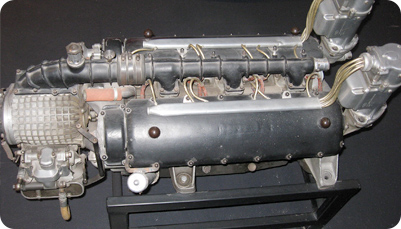
The Colombo V12’s enduring relevance comes from a single design decision: the 90mm bore centre spacing of the original block. That dimension gave Ferrari room to increase displacement repeatedly without redesigning the fundamental architecture. Bores grew. Strokes grew. Displacements climbed from 1.5 liters through 2.0, 2.3, 2.6, 3.0, 3.3, and 4.0 liters before reaching the 4.4-liter unit that powers every front-engine car in the Ferrari 365 series.
The 250 series, introduced in 1952 with a 73mm bore and 58.8mm stroke for 2,953cc, was the engine’s commercial breakthrough. It ran through more than a decade of production and established the Colombo V12 as the foundation of Ferrari’s grand touring identity. When Ferrari needed more displacement for the 330 series in 1963, the block was redesigned with wider 94mm bore spacing, preserving the architecture while opening up room for further growth.
The Four-Cam Revolution
The most significant mechanical development in Colombo V12 Ferrari 365 engine history arrived in 1967, with the 275 GTB/4. Ferrari added a second overhead camshaft per bank, producing the quad-cam configuration that the /4 suffix in multiple 365 model designations directly references. The valve angle was reduced from 60 to 54 degrees for a more compact head. The result was a fundamentally more capable engine at high revs, with six Weber carburetors and dry sump lubrication producing 325 horsepower at 8,000 rpm.
This four-cam architecture carried directly into the 365 series. The Ferrari 365 GTB/4 Daytona and the Ferrari 365 GTS/4 retained the dry sump configuration and downdraft carburetor layout of the 275 GTB/4, producing 352 horsepower. The Ferrari 365 GTC/4 used the same quad-cam architecture but switched to a sidedraft carburetor arrangement and wet sump lubrication to allow a lower bonnet line, producing 340 horsepower. The Ferrari 365 GT4 2+2 carried the same wet sump quad-cam unit forward through 1976.
The twin-cam cars, including the Ferrari 365 GT 2+2 and the earlier 365 GTC, used a single overhead camshaft per bank with three Weber carburetors producing 320 horsepower. These engines prioritized broad torque delivery and low-speed tractability over outright high-rev performance, which aligned precisely with the grand touring mission of those models.
Ferrari Colombo V12 Specifications in the Ferrari 365 Series
The 365 series takes its name directly from the Colombo engine. Each model designation references the single-cylinder displacement in cubic centimeters: 365cc per cylinder, twelve cylinders, 4,390cc total. Every car in the series shares the same 81mm bore and 71mm stroke. John Castrogiovanni, founder of 365Ferrari, notes that knowing exactly which Colombo variant your car carries is the starting point for any serious mechanical work or provenance research on these cars.
Twin-cam configuration (SOHC per bank):
Applied to the 365 GT 2+2 (1968-1971) and 365 GTC (1968-1970). Single overhead camshaft per bank, three Weber 40 DFI carburetors, wet sump lubrication. Output: 320 horsepower at 6,600 rpm.
Quad-cam, downdraft configuration (DOHC per bank):
Applied to the 365 GTB/4 Daytona (1968-1973) and 365 GTS/4 (1969-1973). Dual overhead camshafts per bank, six Weber 40 DCN carburetors, dry sump lubrication. Output: 352 horsepower at 7,500 rpm. The only 365-series engine with dry sump lubrication.
Quad-cam, sidedraft configuration (DOHC per bank):
Applied to the 365 GTC/4 (1971-1972) and 365 GT4 2+2 (1972-1976). Dual overhead camshafts per bank, six Weber 38 DCOE sidedraft carburetors, wet sump lubrication. Output: 340 horsepower at 6,800 rpm. The sidedraft layout reduced bonnet height and moved to a conventional wet sump system.
The Engine That Outlasted Everything
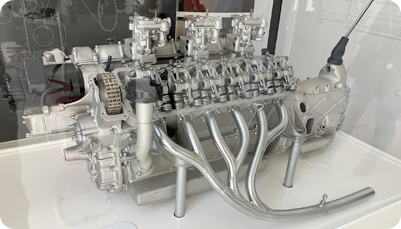
The Ferrari Colombo V12 production run from 1947 to 1988 is a record no other Ferrari engine has matched. After the 365 series concluded in 1976, Ferrari enlarged the wet sump quad-cam unit to 4,823cc for the 400, then to 4,943cc for the 412i. Bosch K-Jetronic fuel injection replaced the carburetors in 1979 for the 400i. The fundamental architecture Colombo had specified in 1947, with its 60-degree vee and its deliberately generous bore centres, accommodated every one of those changes without requiring a ground-up redesign.
For owners and collectors of the 365 series, the Colombo V12’s longevity has a direct practical consequence. The engine architecture is shared across a broader family of cars than most buyers initially realize, and the specialist knowledge required to maintain it correctly is correspondingly well-developed. Parts sourcing for the 365 variants benefits from the engine’s long production run and the supplier relationships that decades of mechanical continuity have established.
Knowing which specific Colombo variant your car carries, and what its factory configuration specifies for carburetion, lubrication, and valve timing, is the starting point for any serious mechanical work. The 365Ferrari registry built and maintained by John Castrogiovanni, preserves chassis-level build records that confirm original engine specification for documented cars, which matters significantly when sourcing components or establishing provenance for a car that has passed through multiple owners.
58.8mm Stroke:
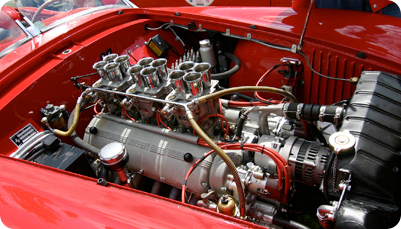 The early 166, 195, and 212 cars used Colombo V12s of varying sizes. All shared the same 58.8 mm (2.31 in) stroke, with 60, 65, and 68 mm (2.68 in) bores giving displacements of 1,995 cc (2.0 L; 121.7 cu in) in the 166, 2,341 cc (2.3 L; 142.9 cu in) in the 195 and 2,563 cc (2.6 L; 156.4 cu in) in the 212, respectively. Output ranged from 105 PS (104 hp; 77 kW) to 165 PS (163 hp; 121 kW).
250:
 One of the most common Colombo engines is the 250, which debuted in 1952 in the 250S and lasted through the 1963 330 America. It used a 73 mm (2.87 in) bore with the common Colombo stroke of 58.8 mm (2.31 in) for a total of 2,953 cc (3.0 L).
Beginning with the famous 250 TR, “Testa Rossa” racing car, Ferrari began a new series of modifications to the Colombo 250 engine. The spark plugs were moved to the outside of the cylinder head, near the exhausts. This enabled Ferrari to introduce separate individual intake ports to use with the six two barrel Weber carburetors. Four cylinder head bolts per cylinder were introduced (instead of three) to cope with the added power.
These changes eventually were incorporated into the Ferrari road cars, beginning with the 250 GT SWB and the 250 GT Series II Pininfarina cars.
275:
 The final 58.8 mm (2.31 in) Colombo Ferrari was the 275. It used a 3,286 cc (3.3 L; 200.5 cu in) variant of the V12 with a wide 77 mm (3.03 in) bore for up to 300 PS (296 hp; 221 kW).
330:
 The 1960 400 Superamerica replaced the previous model’s Lampredi engine with a 3,967 cc (4.0 L; 242.1 cu in) Colombo. It diverged from the standard 58.8 mm (2.31 in) stroke with a 71 mm (2.80 in) stroke and 77 mm (3.03 in) bore. Output was 340 to 400 PS (335 to 395 hp; 250 to 294 kW) with triple Weber carburetors.
Although the 1963 330 series also used a 3,967 cc (4.0 L; 242.1 cu in) engine with the same bore and stroke as the 400 Superamerica, this 300 PS (221 kW; 296 hp) engine was quite different. It used a wider bore spacing, paving the way for future displacement increases. The spark plugs were moved and a new water pump was used. The dynamo on the prior versions was replaced by an alternator.
Four-Cam:
The Colombo V12 was substantially reworked for 1967’s 275 GTB/4. It still used two valves per cylinder, but dual overhead cams were now used as well. In a departure from previous Ferrari designs, the valve angle was reduced three degrees to 54° for a more-compact head. The dual camshafts also allowed the valves to be aligned “correctly” (perpendicular to the camshaft) instead of offset as in SOHC Ferraris. It was a dry-sump design with a huge 16 L (17 US qt) capacity. The engine retained the bore and stroke dimensions of the 275 model for 3,286 cc (3.3 L; 200.5 cu in) of displacement. Output was 330 PS (325 hp; 243 kW) at 8000 rpm and 240 lb⋅ft (325 N⋅m) of torque at 6000 rpm with six 40 DCN 9 Weber carburetors.
365:
The 330 Colombo engine was enlarged with an 81 mm (3.19 in) bore to 4,390.35 cc (4.4 L; 267.9 cu in) for 1966’s 365 California, retaining single overhead cams and wet sump lubrication. A reworked engine with four camshafts was used in the GT/4 models. The 365 GTB/4 Daytona was the only 365 engined car featuring dry sump lubrication.
Applications:
- 1966–1967 365 California
- 1968–1970 365 GTC
- 1968–1971 365 GT 2+2
- 1968–1973 365 GTB/4 Daytona, 365 GTS/4 Daytona
- 1969 365 GTS
- 1971–1972 365 GTC/4
- 1972–1976 365 GT4 2+2
400, 412:
The wet sump, four-cam, 365 Colombo engine was enlarged again to 4,823.16 cc (4.8 L; 294.3 cu in) for 1976’s 400 with the same 81 mm (3.19 in) bore and a 78 mm (3.07 in) stroke. The carburetors were replaced with Bosch K-Jetronic fuel injection in 1979. In 1986 the engine was bored to 82 mm (3.23 in) giving a displacement of 4,943.03 cc (4.9 L; 301.6 cu in).
Applications:
References:
- “Ferrari 125 S”. ferrari.comRetrieved 11 July 2019.
- “Ferrari 330 GT 2+2”. Ferrari. Retrieved 16 June 2015.
- Shea, Terry (September 2014). “1964 Ferrari 330 GT”. Hemmings Motor News. American City Business Journals. Retrieved 16 June 2015.
- Acerbi, Leonardo (2006). Ferrari: A Complete Guide to All Models. Motorbooks. p. 5. ISBN 9780760325506.
- “The Story of the V12: The Engine That Made Ferrari”. JBR Capital. Retrieved 2018-04-23.
- “Ferrari 250 GT Zagato”. FineSportsCars.com. Archived from the original on 2021-01-08. Retrieved 2020-05-31.
- “Ferrari 250 GT Berlinetta Passo Corto”. myAutoWorld. Retrieved 2020-05-31.
- “Ferrari 250 GT Series II Story”. Collezione by MS. Archived from the original on 2018-08-27. Retrieved 2020-05-31
- https://www.colomboandco.com/chronicles/colombo-engine
Ferrari 365 Events: Cars and Coffee
Where Our Community Shows Up There is a [...]
