

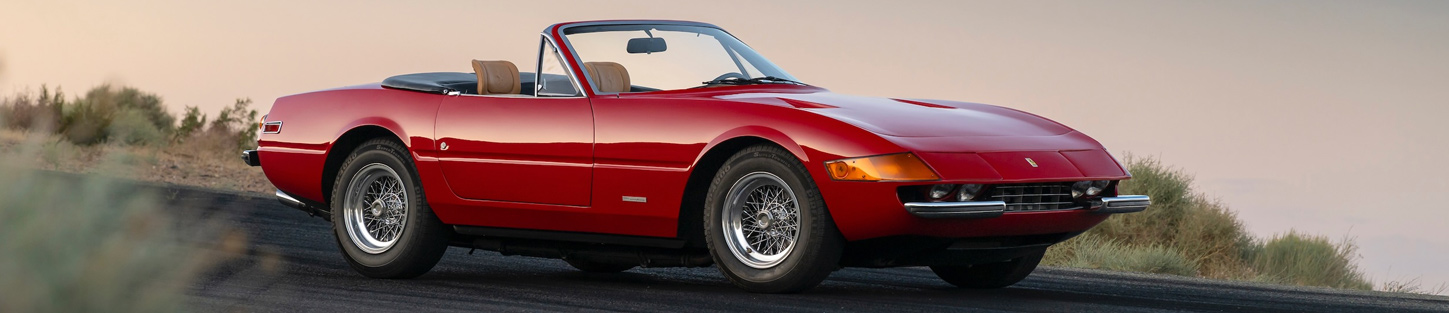
Ferrari 365 Matching Numbers:
What They Mean and How They Affect Value
Ferrari 365 matching numbers are frequently discussed when evaluating the originality, history, and value of a particular car. In the simplest sense, the term describes a Ferrari that retains major components associated with it when it left the factory, most importantly its original engine. Depending on the model and the documentation available, collectors may also consider the gearbox, body, chassis, and other numbered components when assessing originality.
With vintage Ferraris, however, “matching numbers” is not always as straightforward as comparing one number with another. Ferrari used different identification and numbering practices across models and production periods, and those conventions can vary within the 365 family itself. Establishing whether a component belongs to a particular chassis may therefore require more than inspecting the numbers stamped on the car.
Factory records, build information, historical documents, previous ownership records, restoration invoices, photographs, and specialist research can all contribute to establishing a car’s identity. This becomes particularly important when evaluating a Ferrari 365 that has undergone an engine replacement, major restoration, accident repair, body conversion, or other significant work during its life.
Matching numbers can have an important influence on collectibility and value, particularly for rare or highly original examples. They are not, however, the only measure of a Ferrari 365’s quality or desirability. Condition, provenance, specification, restoration quality, completeness, documentation, and the history of the individual chassis should all be considered alongside the originality of its major components.
What Does “Matching Numbers” Mean on a Ferrari 365?
A matching-numbers Ferrari 365 generally retains the major components originally associated with that particular chassis when the car was built. Most importantly, this typically refers to the original engine, although the gearbox, body, chassis, and other numbered components may also be considered when evaluating a car’s originality.
The term can be misleading because “matching” does not necessarily mean the chassis, engine, gearbox, and body all display the same numerical sequence. Ferrari used different numbering systems for different components, and those practices could vary by model and production period. The objective is therefore not to find identical numbers throughout the car but to establish whether each significant component is the one originally assigned to that chassis.
This distinction becomes important when evaluating replacement components. An original component is the component fitted to the individual car when new. A correct-type replacement is the appropriate component specification for that model but was not originally installed in that particular chassis. A period-correct replacement may have been manufactured during the appropriate era without being original to the car. A factory replacement was supplied by Ferrari to replace an original component, while a restamped component has had identifying numbers stamped or altered after manufacture.
These distinctions can have very different implications for originality, provenance, and value. A correct engine of the proper type may allow a Ferrari 365 to perform exactly as intended, for example, but that does not automatically make it the car’s original matching-numbers engine.
Matching Numbers vs. Original Components
“Matching numbers” and “original components” are often used interchangeably in collector-car descriptions, but they should not automatically be treated as identical claims. An original component is one that can be established as having belonged to the car when it was built. A matching-numbers claim generally means that the relevant numbered components can be connected to that specific chassis through their identifying numbers and supporting historical evidence.
Documentation is therefore critical. Factory information, historical records, restoration invoices, previous sales documentation, photographs, and specialist research can help establish whether an engine, gearbox, or other major component is original to a particular Ferrari 365.
Buyers should be especially cautious when a matching-numbers claim is based solely on the presence of apparently correct stampings. The numbers themselves are evidence, but they should be considered alongside the documented history of the car and the physical characteristics of the component.
Why Ferrari 365 Numbers Don’t Always Literally Match
Ferrari did not necessarily assign the same identifying number to every major component installed in a car. A chassis number might identify the car itself, while its engine, gearbox, and body could carry numbers belonging to separate production sequences.
Engines can also contain more than one identifying number. Depending on the model and production period, a Ferrari engine may carry information identifying its type as well as an internal or assembly number used during production. Those numbers serve different purposes and should not automatically be expected to correspond directly with the chassis number.
The same principle can apply to gearbox and body numbers. Ferrari’s production and identification practices also evolved over time, making it particularly important to understand the conventions applicable to the specific 365 model being examined. For that reason, verifying Ferrari 365 matching numbers requires more than looking for identical stampings. The relevant engine, gearbox, body, and chassis numbers must be interpreted within the production practices of that particular model and then compared with available factory and historical documentation to determine whether the components are genuinely original to the car.
Which Numbers Matter on a Ferrari 365?
Introduce the identifiers buyers and collectors should understand.
| Number | What It Identifies | Why It Matters |
| Chassis/Serial Number | Identity of the vehicle | Establishes which Ferrari is being evaluated |
| Engine Number | Engine assembly | Helps establish whether the original engine remains |
| Numero Interno | Internal engine production number | Provides an additional authentication reference |
| Gearbox Number | Transmission | Can help establish drivetrain originality |
| Body Number | Coachbuilt body | Can help connect the body with the original chassis |
| Data Plate | Factory identification information | Provides another reference for verifying identity |
No single number should necessarily be treated as conclusive evidence of originality. Instead, these identifiers should be considered together and compared with available factory records, historical documentation, restoration records, and the known history of the individual chassis.
The identifiers present, their formats, and their physical locations can also vary depending on the specific Ferrari 365 model and production period. A number or stamping that is appropriate for one 365 model should not automatically be expected to appear in the same format or location on another. Buyers should therefore verify numbers according to the conventions of the particular model being examined rather than applying one standard across the entire 365 family.
Ferrari 365 Chassis and Serial Numbers
The chassis number is the primary identifier of an individual Ferrari 365 and provides the starting point for researching its history. When collectors, historians, auction houses, or registries refer to a particular 365 by chassis number, they are identifying that specific car rather than simply its model or specification.
For cars of this period, “chassis number” or “serial number” is generally more appropriate terminology than the modern 17-character Vehicle Identification Number, or VIN. Ferrari 365 models predate the standardized VIN system used on later automobiles, so their identification numbers follow Ferrari’s own conventions from the period.
Buyers should distinguish between the number physically stamped into the chassis and information appearing on factory identification plates. Both can provide useful evidence, but neither should be considered in isolation. The physical stamping, identification plates, registration documents, factory information, historical records, restoration paperwork, and previous sales records should tell a consistent story.
Any discrepancy deserves further investigation. A replaced identification plate does not necessarily indicate a problem, particularly on a car that has undergone restoration, but unexplained differences between physical identification and documented history should be resolved before accepting claims about a Ferrari 365’s identity or provenance.
Where Is the Chassis Number on a Ferrari 365?
The location of the chassis number varies across the Ferrari 365 family, so buyers should not assume that every model uses the same placement. Depending on the model and production period, identifying information can include a number stamped directly into the chassis as well as information displayed on a separate factory identification plate.
Because the 365 designation covers nine distinct models produced over roughly a decade, a model-specific reference should be used before attempting to locate or authenticate a stamping. The stamping location and format appropriate to a Ferrari 365 GTC, for example, should not automatically be assumed to apply to a Daytona or 365 GT4 BB.
Once located, the stamping should be examined as part of the broader classic Ferrari authentication process. Its number, location, format, surrounding metal, and relationship to the car’s documented history can all be relevant. For a significant purchase, these details should be inspected by someone familiar with the particular Ferrari 365 model.
What Can a Ferrari 365 Chassis Number Tell You?
A Ferrari 365 chassis number establishes the identity around which the rest of the car’s history can be researched. It can help confirm the model, place the car within an approximate production sequence, and connect an individual example with surviving factory and historical records.
The chassis number can also be used to trace previous ownership, auction appearances, restoration history, period photographs, registry entries, and other documentation accumulated during the car’s life. For rare models, this research can be particularly valuable because individual chassis may have well-documented histories extending back decades.
The chassis number does not, by itself, prove that the engine, gearbox, body, or other major components remain original. Instead, it provides the reference point against which those components and their identifying numbers can be researched. Establishing a matching-numbers Ferrari 365 ultimately requires connecting those individual pieces back to the correct chassis through reliable documentation and specialist research.
Ferrari 365 Engine Numbers and Numero Interno
The engine is often the component collectors focus on most closely when discussing Ferrari 365 matching numbers. For most of the family, that means establishing whether the car retains the particular 4.4-liter Colombo V12 originally installed in its chassis. The Ferrari 365 GT4 BB is the important exception, using a mid-mounted 4.4-liter flat-12 rather than the front-mounted Colombo V12 found in the other 365 models.
Identifying an engine requires more than confirming that it is mechanically correct for the model. Ferrari engines can carry information identifying the engine type as well as numbers associated with the individual engine itself. These identifiers serve different purposes, and understanding the distinction is important when evaluating originality. An engine of the correct type confirms that its basic specification is appropriate for the model, but it does not establish that the engine is original to that particular car. Two Ferrari 365s of the same model may have engines of the same type, while only one retains the engine installed when it was built.
Buyers should also avoid assuming that an original Ferrari 365 engine must display the same numerical sequence as the chassis. Ferrari’s identification and production practices varied across models and periods, and engine numbering did not always correspond directly with the chassis number. Verification therefore requires interpreting the markings according to the particular model and comparing them with factory information and the documented history of the car. This is especially important when an engine has been rebuilt, replaced, exchanged, or restamped at some point during the Ferrari’s life. A visually correct engine with appropriate specifications is not automatically a matching-numbers engine.
What Is a Ferrari Numero Interno?
The numero interno, or internal number, is an additional production identifier associated with a Ferrari engine. It is distinct from the engine type and other identifying numbers that may appear on the assembly.
For historians and Ferrari specialists, the numero interno can provide another reference when researching whether an engine is consistent with a particular car. Because Ferrari’s various engine identifiers did not necessarily follow the same sequence as the chassis numbers, the internal number can help place an engine within the broader production record and provide another piece of evidence when its history is being reconstructed.
The numero interno should not be treated as a standalone guarantee that an engine is original. Instead, it should be evaluated alongside the engine type, other engine identification, chassis number, factory information, historical records, restoration documentation, and known history of the individual Ferrari.
This distinction is particularly important when researching a car whose engine history is uncertain. An internal number consistent with the expected production period may support other evidence, while an inconsistency may warrant additional research. The objective is to build a documented connection between the engine and the chassis rather than relying on any single stamping.
What If a Ferrari 365 Has a Replacement Engine?
A replacement engine does not automatically make a Ferrari 365 undesirable, but the nature and history of that replacement matter considerably when evaluating originality and collector value.
- Original engine is the engine installed in the specific chassis when the car was built. When that relationship can be supported through the appropriate identification numbers and documentation, it is generally what collectors mean when describing the engine as matching numbers.
- Factory replacement engines are different. Ferrari may have supplied an engine to replace the original unit during the car’s life. Although such an engine can have legitimate factory provenance and may be historically significant in its own right, it is still important to distinguish it from the engine originally fitted to the chassis.
- Period-correct engine comes from the appropriate era and may share characteristics with the engine originally used in the car, but it was not necessarily built for that particular chassis. Likewise, a correct-type replacement is an engine of the proper specification for the model without being the original engine assigned to the car.
- Later replacement may have been installed considerably later in the Ferrari’s history. Its significance depends on what was installed, why the replacement occurred, how accurately the engine reflects the original specification, and how thoroughly the change is documented.
These distinctions can have very different implications in the collector market. A Ferrari 365 retaining its documented original engine represents a different level of originality from an otherwise identical car fitted with a correct-type replacement. At the same time, a properly documented factory replacement or period-correct engine may be viewed very differently from an undocumented engine of uncertain origin.
For buyers, the important question is therefore not simply whether an engine is “matching.” It is which engine is currently in the car, how it relates to the original chassis, and what evidence supports that history. That distinction provides a much more meaningful picture of a Ferrari 365’s originality than the matching-numbers label alone.
Do the Gearbox and Body Numbers Matter?
Yes, although the engine often receives the most attention when collectors discuss Ferrari 365 matching numbers, the gearbox and body can provide additional evidence of a car’s originality. Their significance may differ from that of the engine, but both can help establish whether the major components present today are those originally associated with the chassis.
This is particularly useful when evaluating a Ferrari that has undergone restoration, accident repair, drivetrain work, or other significant changes during its life. As with engine numbers, gearbox and body numbers should be interpreted according to the practices used for the specific 365 model rather than simply compared numerically with the chassis number.
Ferrari 365 Gearbox Numbers
A gearbox number identifies the transmission assembly and can help determine whether a Ferrari 365 retains its original drivetrain. This is relevant across a family that used several different drivetrain arrangements, including the rear-mounted transaxles found in models such as the Ferrari 365 GTS, 365 GTC, and 365 GTB/4 Daytona.
An original gearbox is the unit associated with the car when new. If that gearbox was replaced during the Ferrari’s life, a replacement may still be correct for the model without being original to the individual chassis.
Buyers should not assume that a gearbox number must duplicate the chassis number. The gearbox may belong to its own numbering sequence, so establishing originality requires understanding the numbering convention for the particular model and comparing the number with available factory and historical information.
For collectors seeking a highly original Ferrari 365, confirmation of the original gearbox can strengthen the car’s overall provenance. It should still be considered as one part of the larger picture alongside the engine, body, chassis, documentation, condition, and known history.
Ferrari 365 Body Numbers
Body numbers can provide another useful reference when researching the originality of a Ferrari 365. These numbers relate to the production of the coachwork and should not automatically be expected to correspond numerically with the car’s chassis number.
Pininfarina played a central role in the design and coachwork history of the 365 family, while Scaglietti was involved in the construction of certain Ferrari bodies during the period. Because the precise production process differed among models, the meaning, format, and location of a body number should be researched specifically for the Ferrari 365 being evaluated.
When properly documented, a body number can help connect surviving coachwork with a particular chassis and provide supporting evidence when investigating whether the car retains its original body. This can become especially important when a Ferrari has experienced substantial restoration or accident repair, or when its body configuration is central to its identity.
The Ferrari 365 GTB/4 and GTS/4 illustrate why this matters. Numerous Daytona coupes were later converted into spider configurations, so a car that visually resembles a Daytona Spider should not be assumed to be an original factory Ferrari 365 GTS/4. The buyer must establish that the chassis itself was originally produced in that specification and then consider the body and supporting documentation as part of the authentication process.
As with every other identifying number on a Ferrari 365, a body number is most useful when it supports a consistent documented history. It is another piece of evidence, not a substitute for researching the individual chassis.
Do Matching Numbers Affect Ferrari 365 Value?
Yes, matching numbers can contribute to the desirability and value of a Ferrari 365, particularly when the car retains its original engine and other major components. There is no universal percentage premium, however, that can be applied across every model or every car. The significance of matching numbers depends on the Ferrari being evaluated and how originality fits into its broader history.
Model and rarity are important. An original drivetrain can carry particular significance on a scarce Ferrari, such as a Ferrari 365 California, 365 GTS, or factory 365 GTS/4 Daytona Spider, where relatively few examples were produced. On other 365 models, matching numbers may still be desirable, but condition, restoration quality, specification, and usability can carry considerable weight in the market as well. Production numbers vary substantially across the 365 family, which is one reason values and collector priorities differ by model.
The original engine is generally one of the most important considerations because it represents a major part of the car’s mechanical identity. Retaining the original gearbox can further support drivetrain originality, while an original body can become particularly significant when evaluating a car that has undergone extensive restoration, accident repair, or a change in body configuration.
Matching numbers should never be evaluated in isolation. Provenance and documentation need to support the claims being made about the car. Factory information, ownership history, restoration invoices, service records, previous sales documentation, period photographs, and specialist research can all help establish whether the components currently present belong to the chassis.
Overall condition and restoration quality matter as well. A matching-numbers Ferrari that requires extensive mechanical or structural work is not automatically more desirable than every properly restored example with a documented replacement component. Likewise, a Ferrari restored to its documented factory specification may appeal differently from one that retains its original drivetrain but has undergone significant undocumented modifications elsewhere.
Ultimately, the effect of matching numbers on Ferrari 365 value depends on the combination of model, rarity, original engine, original gearbox, original body, provenance, documentation, restoration quality, overall condition, factory specification, and current market demand. Matching numbers can strengthen a car’s collector appeal, but they are one part of a much larger assessment of the individual Ferrari. Read more: What Is My Ferrari 365 Worth?
Ferrari Classiche and Matching Numbers
Ferrari Classiche is Ferrari’s official program for the authentication, certification, restoration, and preservation of historic Ferrari automobiles. For a Ferrari 365, the program can provide an important additional level of documentation because the car is evaluated against Ferrari’s historical records and its original specifications.
During the certification process, the car undergoes a technical inspection in which its authenticity and conformity to its original specifications are examined. Ferrari states that this process draws on its historical archive, including individual chassis drawings and information concerning historical components. The findings are then submitted to an expert committee for certification.
A successfully certified car receives Ferrari Classiche documentation commonly known among collectors as the Red Book. For buyers researching a Ferrari 365, this documentation can provide valuable support for the car’s identity, specification, major components, and overall provenance.
Classiche certification should not, however, be treated as another term for “matching numbers.” There is an important distinction between a component being original to the individual car and being correct to the car’s original specification. Ferrari itself notes that Classiche restoration work may use original components and spare parts or replicas manufactured according to the original specifications.
That distinction matters when evaluating an engine, gearbox, body, or other significant component. A Ferrari may conform to the correct factory specification while incorporating a replacement component, and the history and status of that component should still be understood separately when assessing matching numbers.
Likewise, the absence of Ferrari Classiche certification does not automatically mean that a Ferrari 365 is non-matching or inauthentic. Classiche is a certification process, not a prerequisite for a car to retain its original components. An uncertified 365 may still have its original engine, gearbox, body, and other significant components, supported by factory information, historical documentation, specialist research, and the physical evidence found on the car.
For that reason, Ferrari Classiche certification is best viewed as an important source of authentication and provenance rather than a substitute for understanding the individual car. Whether certified or not, a Ferrari 365 should still be evaluated through its identifying numbers, factory specification, component history, documentation, restoration history, and the known history of its chassis.
How to Verify a Matching-Numbers Ferrari 365
Verifying a matching-numbers Ferrari 365 requires more than checking a single engine stamping. The goal is to establish whether the major components currently fitted to the car are the ones originally associated with that particular chassis and whether the available documentation supports that conclusion. Buyers should approach the process methodically:
- Confirm the chassis number. Begin with the car’s primary identity. Compare the physical chassis stamping with identification plates, registration documents, factory information, and historical records.
- Record the engine number and numero interno where applicable. Document the engine type and identifying numbers exactly as they appear. Remember that the engine number should not automatically be expected to duplicate the chassis number.
- Record the gearbox number. Where the gearbox or transaxle carries an identifying number, document it and determine whether available records support it as the unit originally associated with the chassis.
- Locate applicable body numbers. Body or coachbuilder production numbers can provide another reference when investigating whether the car retains its original body. Their format and location can vary by model.
- Review factory and historical documentation. Compare the numbers found on the car with available factory information, ownership records, historic photographs, previous sales documentation, registry information, and other reliable records connected with the chassis.
- Compare service and restoration records. Invoices and restoration documentation can reveal engine rebuilds, gearbox replacements, accident repairs, bodywork, or other changes that may explain differences between the car’s current configuration and its original specification. Documentation and provenance are an essential part of establishing a Ferrari 365’s history.
- Examine stampings for evidence of alteration. Identifying numbers should be inspected in context, including the surrounding metal and the apparent style and consistency of the stamping. Anything unusual should prompt further research rather than an immediate conclusion about originality.
- Have a vintage Ferrari specialist inspect the car. A specialist familiar with the specific 365 model can evaluate identifying numbers alongside mechanical components, construction details, restoration work, and known production practices. Independent verification is particularly important before a significant purchase.
- Use Ferrari factory or Classiche documentation where available. Factory records and Ferrari Classiche documentation can provide additional evidence when establishing original specifications and component history. They should be considered alongside the physical car and its broader documented provenance.
No individual number or document should automatically settle a matching-numbers claim. The strongest conclusion comes when the physical identifiers, factory information, historical documentation, restoration and service records, and specialist inspection all support the same history for the individual Ferrari 365.
Ferrari 365 Matching Numbers FAQs
What Makes a Ferrari 365 Numbers Matching?
A Ferrari 365 is generally considered matching numbers when its major numbered components, most importantly the engine, can be established as the components originally associated with that specific chassis. Depending on the model, collectors may also examine the gearbox, body number, numero interno, and other identifying information. The numbers do not necessarily need to be identical because Ferrari used different numbering sequences for different components and production periods. A matching-numbers claim should therefore be supported by physical inspection, factory and historical documentation, service and restoration records, and specialist research rather than by comparing the chassis and engine numbers alone.
How Important Are Matching Numbers on a Ferrari 365?
Matching numbers can be an important factor in the originality, collectibility, and value of a Ferrari 365, particularly when the car retains its original engine and other major components. Their importance varies, however, depending on the model, rarity, condition, provenance, documentation, restoration quality, and overall history of the individual car. A matching-numbers example with strong documentation may be particularly desirable to collectors seeking originality, but matching numbers alone do not determine value. A Ferrari 365 should be evaluated as a complete car, including its mechanical condition, factory specification, restoration history, and provenance.
What Documents Prove a Ferrari 365 Is Matching Numbers?
No single document necessarily proves that a Ferrari 365 is matching numbers. Verification is strongest when factory information and historical records can be compared with the identifying numbers physically present on the car. Useful evidence may include Ferrari factory or Classiche documentation, original ownership records, service history, restoration invoices, previous sales records, period photographs, and specialist or registry research. These records can help establish whether the engine, gearbox, body, and other major components are original to the chassis. Buyers should compare documentary evidence with a physical inspection rather than relying solely on a seller’s statement or one historical record.
Is Ferrari Classiche Certification Worth It for a Ferrari 365?
Ferrari Classiche certification can be valuable for a Ferrari 365 because it provides factory-backed documentation of the car’s identity, specification, and major components. This can be particularly useful for rare, highly original, or extensively restored examples where provenance and authenticity are important to collectors. However, Classiche certification is not required for a Ferrari 365 to be matching numbers. An uncertified car may still retain its original engine, gearbox, body, and other components if that history can be established through factory records, historical documentation, physical inspection, and specialist research. Whether certification is worthwhile therefore depends on the individual car, its existing documentation, and the owner’s objectives.
Do Ferrari 365 Models Have Matching Engine and Chassis Numbers?
On a Ferrari 365, a matching-numbers engine does not mean the engine number must be identical to the chassis number. Ferrari used different identification and numbering sequences for major components, and those practices could vary by model and production period. Engines may also carry an engine type and a numero interno, or internal engine number, that serve different identification purposes. The important question is whether the engine currently installed can be established as the engine originally associated with that specific chassis. Buyers should therefore verify the relevant numbers against factory information, historical documentation, and specialist research rather than expecting the engine and chassis numbers to literally match.
