

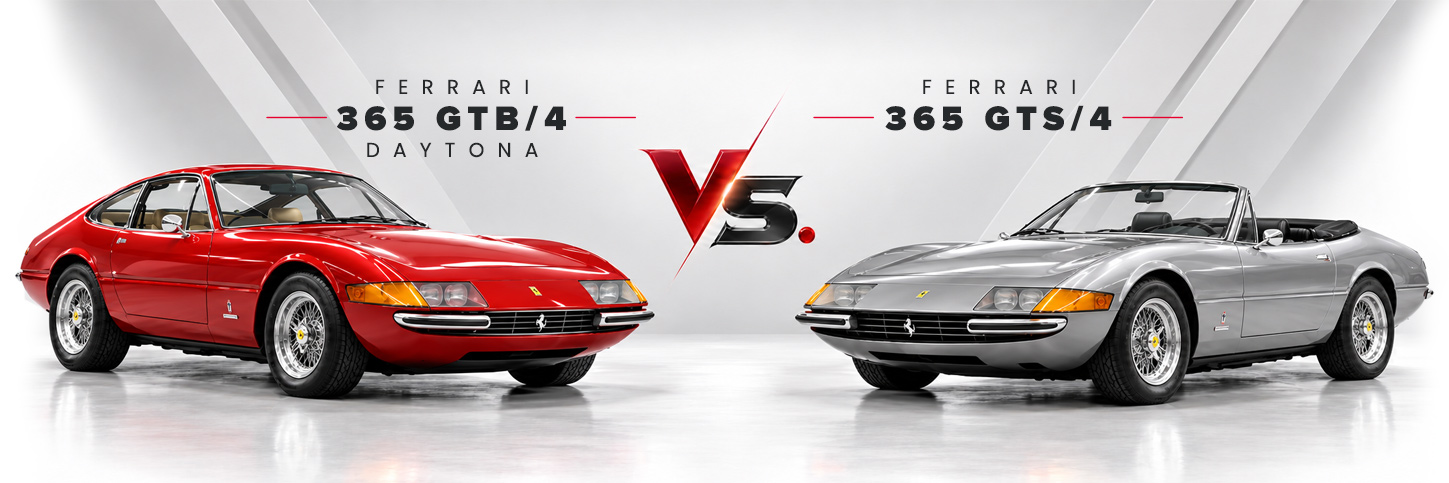
Ferrari 365 GTB/4 Daytona vs. Ferrari 365 GTS/4
The Ferrari 365 GTB/4 Daytona vs. Ferrari 365 GTS/4 comparison brings together two versions of Ferrari’s iconic front-engine V12 grand tourer, each offering a distinct interpretation of performance, styling, and exclusivity. Introduced in 1968, the 365 GTB/4 Daytona is a fixed-roof berlinetta renowned for its aggressive Pininfarina design and exceptional high-speed performance. The 365 GTS/4 Daytona Spider followed in 1969 as its factory-built open-top counterpart, sharing the same 4.4-liter Colombo-derived V12, five-speed rear transaxle, and much of its underlying mechanical architecture. Despite their similarities, production numbers differ significantly, with approximately 1,284 Daytona berlinettas built compared with just 122 factory-built Spiders. These differences in body style and rarity create distinct considerations for driving experience, authenticity, maintenance, market value, and collector appeal. Understanding how the Ferrari 365 GTB/4 Daytona and 365 GTS/4 compare can help prospective buyers determine whether the coupe’s focused driving character or the Spider’s open-air experience and exceptional exclusivity better align with their ownership and collecting priorities.
Ferrari 365 GTB/4 Daytona vs. Ferrari 365 GTS/4: Key Differences
The primary difference between the Ferrari 365 GTB/4 Daytona and Ferrari 365 GTS/4 Daytona Spider is their body configuration. The GTB/4 is a fixed-roof, two-seat berlinetta, while the GTS/4 is its factory-built convertible counterpart. Both share a 4.4-liter Colombo-derived V12, a five-speed rear transaxle, and much of the same underlying mechanical architecture, delivering comparable performance and driving characteristics. However, their body construction, driving experience, production rarity, and collector values differ significantly. With approximately 1,284 GTB/4 coupes produced compared with just 121 factory-built GTS/4 Spiders, the open-top model is considerably rarer and generally commands a substantial premium in the classic Ferrari market.
| Feature | Ferrari 365 GTB/4 Daytona | Ferrari 365 GTS/4 |
|---|---|---|
| Common name | Daytona Coupe | Daytona Spider |
| Production period | 1968–1973 | 1969–1973 |
| Body style | Two-seat berlinetta | Two-seat convertible Spider |
| Engine | 4.4L Colombo V12 | 4.4L Colombo V12 |
| Engine output | Approximately 352 bhp | Approximately 352 bhp |
| Transmission | Five-speed manual rear transaxle | Five-speed manual rear transaxle |
| Roof | Fixed metal roof | Folding convertible top |
| Production | Approximately 1,284 coupes | 122 factory Spiders |
| Driving character | Enclosed, sporting grand tourer | Open-air V12 grand tourer |
| Collector positioning | Highly desirable classic Ferrari | Extremely rare, premium collector Ferrari |
Despite their differences in rarity and market value, the GTS/4 is not a separate high-performance version of the Daytona. Both models share the same fundamental engine specifications and performance capabilities, with the Spider’s convertible construction creating a different driving experience rather than a significant mechanical advantage.
An important distinction for collectors is the difference between an authentic factory-built Ferrari 365 GTS/4 and a Daytona Spider conversion. Due to the substantial value premium associated with original Spiders, some GTB/4 coupes were subsequently converted into open-top configurations. While these conversions may closely resemble factory Spiders, they are not original GTS/4 models and should be evaluated accordingly. Factory documentation, chassis identity, originality, provenance, and restoration quality are essential when assessing authenticity and collector value. Rarity contributes to the GTS/4’s exclusivity, but the condition and documented history of an individual car remain equally important considerations.
Ferrari 365 GTB/4 Daytona vs. Ferrari 365 GTS/4: Design and Styling
Design
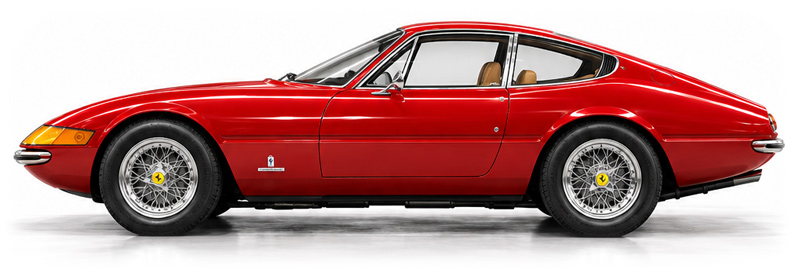
The Ferrari 365 GTB/4 Daytona and Ferrari 365 GTS/4 Daytona Spider share the same distinctive Pininfarina design, characterized by a long hood, sharply defined front end, and muscular proportions. Both models feature Scaglietti-built bodywork, but their roof configurations create noticeably different silhouettes. The GTB/4 emphasizes the Daytona’s sleek fastback styling, while the GTS/4 introduces an open-top design with a folding convertible roof and redesigned rear bodywork.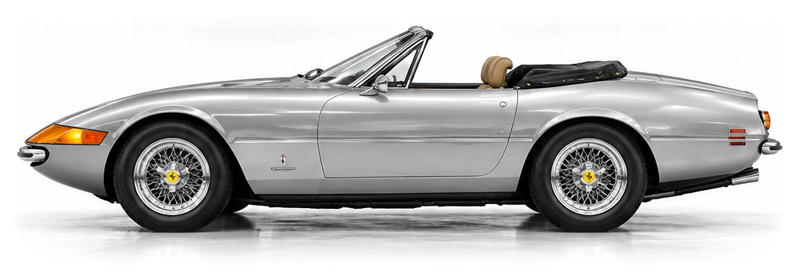
Styling
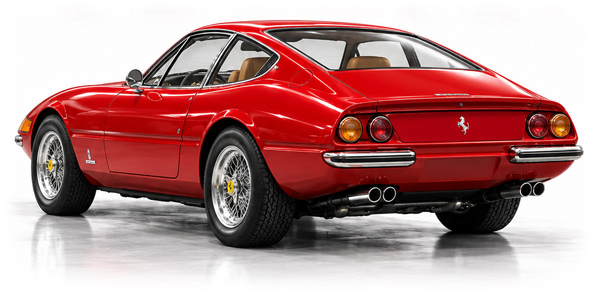
The 365 GTB/4 features a low, elongated profile with a steeply raked windshield and flowing fastback roofline. Its long hood, compact passenger compartment, and tapered nose emphasize its performance-oriented character. Early examples featured headlights concealed behind a Plexiglas nose panel, while later models adopted retractable headlights. The fixed roof creates a continuous, streamlined silhouette that remains one of the Daytona’s defining design features.
The 365 GTS/4 retains the coupe’s recognizable front-end styling and sculpted bodywork but replaces the fastback roof with a folding fabric top. Its revised windshield treatment and flatter rear deck accommodate the convertible configuration, creating a more open profile when the roof is lowered. The Spider also features additional structural reinforcement to compensate for the absence of a permanent roof, helping maintain chassis rigidity and handling characteristics.
For collectors, distinguishing an authentic factory-built GTS/4 from a converted GTB/4 is essential. Numerous Daytona coupes were subsequently converted into Spiders, but these modifications do not give them the same historical significance or market value as original factory examples. Verifying chassis identity, factory records, body construction, and provenance is particularly important when evaluating a Daytona Spider.
Ferrari 365 GTB/4 Daytona vs. Ferrari 365 GTS/4: Engine and Performance
Engine
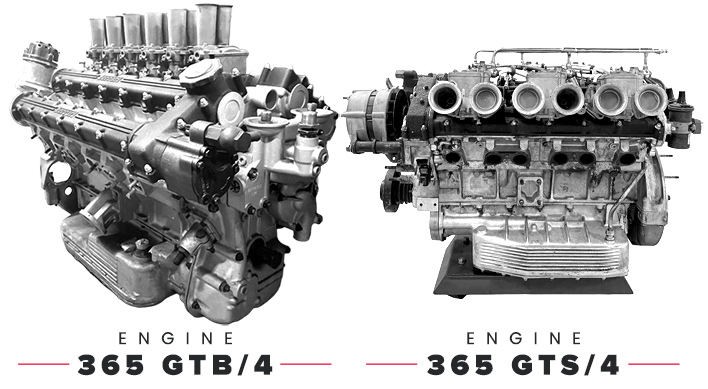 The Ferrari 365 GTB/4 Daytona and Ferrari 365 GTS/4 Daytona Spider share the same 4,390 cc Colombo-derived V12 engine, featuring four overhead camshafts and producing 352 metric horsepower (approximately 347 bhp) at 7,500 rpm. Both models develop approximately 318 lb-ft (431 Nm) of torque at 5,500 rpm, delivering strong acceleration and impressive high-speed performance. Their nearly identical engine specifications mean that neither model offers a significant advantage in horsepower or torque.
Both Ferraris feature six twin-choke Weber carburetors, dry-sump lubrication, and a five-speed manual rear transaxle. The rear-mounted transmission helps distribute weight between the axles, contributing to balanced handling and stability at higher speeds. Ferrari quoted a top speed of approximately 174 mph (280 km/h) for both models, with period road tests recording acceleration from 0 to 60 mph in roughly 5.5 seconds for the Daytona coupe. Actual acceleration figures vary depending on testing conditions and vehicle specifications.
Performance
The primary performance differences stem from their body construction. The GTB/4’s fixed roof contributes to structural rigidity, while the GTS/4 incorporates additional reinforcement to accommodate its convertible configuration. Although these modifications can influence vehicle weight and chassis response, published weight figures vary by source and measurement method. Neither model has a substantial performance advantage solely because of its body style.
For collectors and enthusiasts, mechanical condition often matters more than minor differences in original performance specifications. Carburetor tuning, ignition timing, engine compression, transmission condition, and proper maintenance can significantly affect acceleration, responsiveness, and overall drivability. Both models deliver the distinctive sound and high-revving performance of Ferrari’s four-cam V12, with the choice between them driven primarily by the coupe’s enclosed driving character or the Spider’s open-air experience.
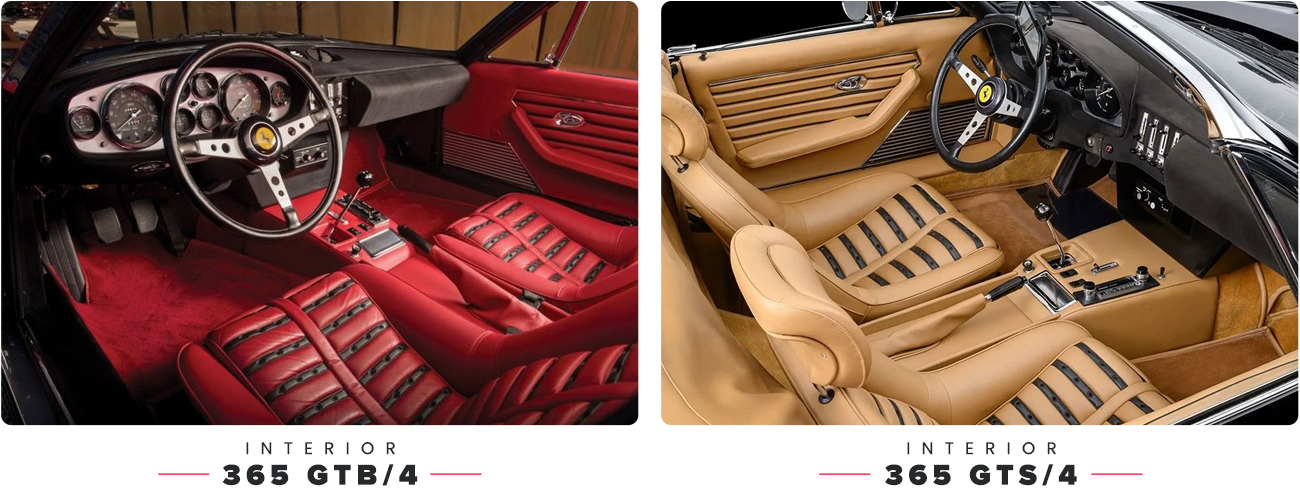
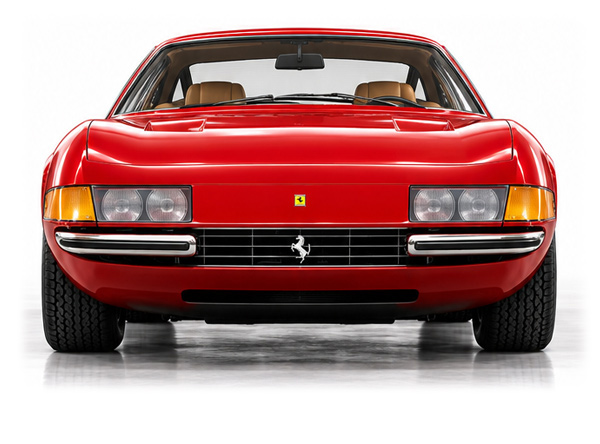
Ferrari 365 GTB/4 Daytona vs. Ferrari 365 GTS/4: Driving Experience and Comfort
The Ferrari 365 GTB/4 Daytona and Ferrari 365 GTS/4 Daytona Spider deliver closely related driving experiences, combining the performance of a front-engine V12 with the engaging characteristics of a traditional Ferrari grand tourer. Both feature unassisted steering, a five-speed manual rear transaxle, and independent suspension, offering balanced handling and a direct connection between the driver and the road. Their primary difference lies in the driving environment, with the GTB/4 emphasizing enclosed grand touring and the GTS/4 providing a more immersive open-air experience.
Ferrari 365 GTB/4 Daytona Driving Experience
The 365 GTB/4’s fixed-roof configuration offers greater protection from wind, weather, and road noise, making it particularly appealing for extended highway journeys and regular use. Its rigid body structure contributes to a composed driving experience, while the enclosed cabin provides more consistent comfort in changing weather conditions. Although the Daytona’s steering can feel heavy at low speeds and its manual gearbox requires deliberate shifts, both become more rewarding as speed increases.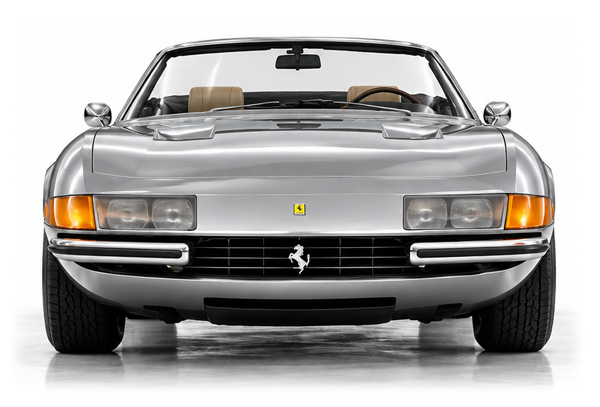
Ferrari 365 GTS/4 Driving Experience
The 365 GTS/4 offers a more engaging sensory experience with its folding convertible roof lowered. Open-air driving allows occupants to hear the V12 engine and exhaust more directly, enhancing the Daytona’s distinctive soundtrack. While the Spider shares the coupe’s fundamental handling characteristics, its reinforced convertible construction and additional weight can introduce subtle differences in steering response and body rigidity. However, these differences are generally less noticeable during relaxed touring than the increased wind exposure and reduced weather protection.
Both models are well suited to weekend drives and longer touring journeys, although their practicality differs. The GTB/4 offers a quieter, more weather-resistant cabin for frequent driving, while the GTS/4 emphasizes the enjoyment of open-air V12 motoring. For buyers choosing between them, the decision largely depends on whether enclosed grand touring comfort or the Spider’s distinctive convertible experience takes priority.
Ferrari 365 GTB/4 Daytona vs. Ferrari 365 GTS/4: Reliability and Maintenance Costs
The Ferrari 365 GTB/4 Daytona and Ferrari 365 GTS/4 Daytona Spider share similar reliability characteristics and maintenance requirements due to their closely related 4.4-liter V12 engines, five-speed rear transaxles, and underlying mechanical systems. Both models can provide dependable grand touring performance when properly maintained, but their age, mechanical complexity, and specialized components require regular servicing by experienced vintage Ferrari specialists. Maintenance costs depend heavily on each vehicle’s condition, service history, and restoration quality rather than its body style alone.
Maintenance
Both engines require careful attention to carburetor synchronization, ignition timing, valve clearances, cooling system performance, and dry-sump lubrication. Aging fuel lines, deteriorating seals, and electrical connections can also create reliability concerns, particularly in cars that have experienced prolonged storage. The clutch, rear-mounted transaxle, suspension bushings, shock absorbers, and four-wheel disc brakes should be inspected for wear and proper operation. Preventative maintenance is essential for preserving the performance and drivability of these classic V12 Ferraris.
Corrosion
Corrosion and previous accident repairs are additional concerns for both models, particularly around the sills, floor panels, wheel arches, and structural sections. Buyers should carefully evaluate the quality of previous bodywork and restorations, as poorly executed repairs can compromise structural integrity and lead to substantial restoration costs. The GTS/4 requires additional attention to its folding convertible roof, weather seals, and drainage areas, where water intrusion can damage interior materials and contribute to corrosion. With only 122 factory-built Spiders produced, sourcing original GTS/4-specific body panels, convertible hardware, and trim components can be particularly challenging and expensive.
Reliability
Neither model is inherently more reliable than the other, although the GTS/4 introduces additional maintenance considerations associated with its convertible configuration. For either model, comprehensive service records, documented restoration work, and a thorough pre-purchase inspection by a qualified vintage Ferrari specialist are essential for identifying potential problems and understanding long-term ownership costs.
Ferrari 365 GTB/4 Daytona vs. Ferrari 365 GTS/4: Rarity, Value, and Collector Appeal
The Ferrari 365 GTB/4 Daytona and Ferrari 365 GTS/4 Daytona Spider are among Ferrari’s most celebrated front-engine V12 grand tourers, with approximately 1,284 GTB/4 berlinettas produced between 1968 and 1973 and just 121 factory-built GTS/4 Spiders. Although both models are highly collectible, the Spider’s exceptional rarity and open-top configuration contribute to its greater exclusivity and substantially higher market values. The GTB/4 remains one of Ferrari’s most recognizable classics, admired for its distinctive Pininfarina styling, four-cam V12 performance, and historical significance.
Market Value
 Recent auction results illustrate the difference in collector valuations. In August 2026, a 1972 Ferrari 365 GTS/4 Daytona Spider sold for $2,315,000 at RM Sotheby’s Monterey auction, while a 1972 Ferrari 365 GTB/4 Daytona berlinetta achieved €545,000 at RM Sotheby’s Monaco auction in April 2026. Another GTB/4 sold for $786,000 at Gooding Christie’s Amelia Island auction in March 2026. These completed transactions demonstrate the substantial premium associated with factory-built Spiders, although individual results vary depending on condition, originality, and provenance. Private-market asking prices may differ significantly from completed auction sales and should not be treated as confirmed market values.
For both models, matching-numbers engines and transaxles, original factory colors, documented ownership history, and restoration quality significantly influence collector confidence and market value. Cars retaining their original bodywork, factory equipment, and well-documented specifications are particularly desirable. Ferrari Classiche certification can provide additional evidence of authenticity, while comprehensive service records and specialist restoration documentation help establish a vehicle’s history.
Authenticity is especially important when evaluating a Ferrari 365 GTS/4 Daytona Spider. Due to the substantial premium associated with factory-built Spiders, numerous GTB/4 coupes were subsequently converted into open-top configurations. Although some conversions closely resemble original GTS/4 models, they generally command lower values because they lack the same factory production history. Buyers should verify chassis identity, original body construction, factory records, and provenance before purchasing.
Collector Appeal
The GTB/4 offers collectors an iconic Ferrari V12 grand tourer at a generally lower acquisition cost, while the GTS/4 commands a significant premium for its limited production and open-air driving experience. However, rarity alone does not determine an individual car’s value. Originality, condition, documented history, and market demand remain essential considerations when evaluating the long-term collector appeal of either model.
Factory Daytona Spiders vs. Coupe-to-Spider Conversions
An original Ferrari 365 GTS/4 Daytona Spider is a factory-built convertible produced by Ferrari and Scaglietti, while a coupe-to-Spider conversion is a Ferrari 365 GTB/4 Daytona that was modified into an open-top configuration after leaving the factory. With only 121 factory Spiders produced, their exceptional rarity and substantial market values encouraged some owners to convert Daytona coupes into convertibles. Although certain conversions closely resemble genuine GTS/4 models, they do not share the same factory production history, originality, or collector status.
The differences extend beyond appearance. Factory-built GTS/4 Spiders incorporated bodywork and structural modifications specifically designed for their convertible configuration. Converted coupes may feature different reinforcement methods, body construction, and restoration techniques depending on when and how the conversion was performed. While a professionally executed conversion can offer an enjoyable open-air driving experience, it generally commands a lower market value than an authentic factory Spider with comparable condition and provenance.
Verifying authenticity requires more than inspecting exterior styling or confirming matching engine and chassis numbers. A converted GTB/4 can retain its original matching-numbers drivetrain without being a genuine GTS/4. Buyers should verify chassis identity against Ferrari’s factory production records, review original specifications, and examine historical ownership documentation. Ferrari 365 matching numbers are important for establishing mechanical originality, but they do not independently confirm factory Spider status.
Ferrari Classiche certification, independent historical research, and a thorough physical inspection by a qualified marque specialist are essential when evaluating a claimed factory GTS/4. Buyers should also review the vehicle’s documentation and provenance to identify previous modifications, restorations, or changes in body configuration. Following a comprehensive Ferrari 365 authentication process helps distinguish an original factory-built Daytona Spider from a later conversion and supports a more informed assessment of its authenticity and collector value.
Ferrari 365 GTB/4 Daytona vs. Ferrari 365 GTS/4: Which Should You Buy?
Choosing between the Ferrari 365 GTB/4 Daytona and Ferrari 365 GTS/4 Daytona Spider depends on your driving preferences, budget, and collecting priorities. Both offer the performance and mechanical character of Ferrari’s 4.4-liter Colombo-derived V12, but their differences in body style, practicality, rarity, and market value make them suited to different types of owners. The GTB/4 emphasizes performance-focused grand touring, while the GTS/4 combines similar mechanical capabilities with the exclusivity and sensory appeal of open-air driving.
Who Should Buy the Ferrari 365 GTB/4 Daytona?
The Ferrari 365 GTB/4 Daytona is particularly well suited to enthusiasts seeking the iconic Daytona driving experience in its original fixed-roof berlinetta configuration. Its powerful V12, balanced handling, and distinctive Pininfarina fastback styling appeal to drivers who appreciate Ferrari’s traditional grand touring philosophy. The enclosed cabin provides greater protection from wind, weather, and road noise, making the GTB/4 a more practical choice for extended journeys and regular driving.
With approximately 1,284 examples produced, the GTB/4 offers considerable exclusivity without the substantial acquisition costs associated with a factory-built GTS/4 Spider. Its historical significance, recognizable design, and engaging driving characteristics make it attractive to collectors who prioritize both enjoyment and long-term ownership. For buyers seeking Daytona performance, classic Ferrari styling, and a generally more accessible purchase price, the GTB/4 presents a compelling option.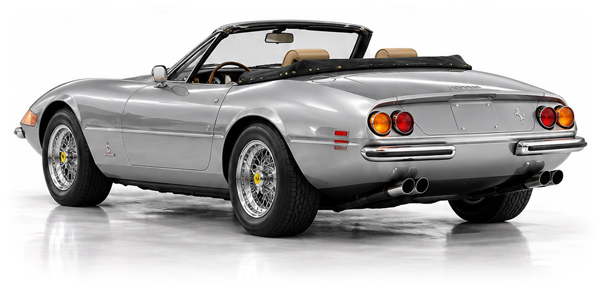
Who Should Buy the Ferrari 365 GTS/4 Daytona Spider?
The Ferrari 365 GTS/4 Daytona Spider is an exceptional choice for collectors who prioritize rarity, historical significance, and the distinctive experience of driving an open-top Ferrari V12. With only 122 factory-built examples produced, the GTS/4 is considerably more exclusive than its coupe counterpart. Its folding convertible roof allows occupants to experience the Daytona’s engine and exhaust soundtrack more directly, making open-air grand touring a defining part of its appeal.
Buyers should be prepared for limited market availability, substantially higher acquisition costs, and the additional considerations associated with maintaining a rare factory-built Spider. Originality, matching numbers, documented factory specifications, and verified chassis identity are particularly important when evaluating a GTS/4. For collectors seeking a historically significant Ferrari for occasional drives, exclusive events, or concours participation, an authentic factory Daytona Spider represents a distinctive opportunity.
The Ferrari 365 GTB/4 Daytona is generally the more practical choice for enthusiasts seeking the classic Daytona driving experience, particularly for regular use and extended touring. The factory-built Ferrari 365 GTS/4 Daytona Spider is especially compelling for collectors who prioritize exceptional rarity, open-air V12 motoring, and historical exclusivity. Both offer closely related mechanical experiences, with the better choice determined by intended use, budget, and individual collecting priorities.
Ferrari 365 GTB/4 Daytona vs. Ferrari 365 GTS/4 FAQs
Why Is the Ferrari 365 GTS/4 Worth More Than the GTB/4?
The Ferrari 365 GTS/4 Daytona Spider is worth more than the Ferrari 365 GTB/4 Daytona primarily because of its exceptional rarity and desirable factory-built convertible configuration. Ferrari produced just 121 GTS/4 Spiders compared with approximately 1,284 GTB/4 coupes, making the Spider significantly harder to acquire. Its open-top Pininfarina styling, historical significance, and exclusive production status further contribute to its collector appeal. Although both models share nearly identical mechanical specifications and performance, authentic factory Spiders generally command substantially higher market values. Individual valuations also depend on originality, matching numbers, documented provenance, restoration quality, and overall condition.
Which Is More Collectible, the Ferrari Daytona Coupe or Spyder?
The Ferrari 365 GTS/4 Daytona Spider is generally considered more collectible than the Ferrari 365 GTB/4 Daytona coupe due to its exceptional rarity, factory-built convertible configuration, and substantially higher market values. With only 121 factory Spiders produced compared with approximately 1,284 coupes, the GTS/4 is among Ferrari’s most exclusive classic V12 grand tourers. Its open-top Pininfarina styling and limited availability make it particularly desirable among collectors. However, the GTB/4 remains highly collectible for its iconic fastback design, performance, and historical significance. For both models, originality, matching numbers, documented provenance, and restoration quality significantly influence individual collector value.
Which Is Faster, the Ferrari 365 GTB/4 or GTS/4?
The Ferrari 365 GTB/4 Daytona and Ferrari 365 GTS/4 Daytona Spider offer nearly identical performance, with neither model holding a significant advantage in outright speed. Both feature a 4.4-liter Colombo-derived V12 producing 352 metric horsepower and a five-speed manual rear transaxle. Ferrari quoted a top speed of approximately 174 mph (280 km/h) for both models. Although the GTB/4’s fixed-roof design and the GTS/4’s reinforced convertible construction can create minor differences in weight, aerodynamics, and acceleration, these variations are relatively small. In practice, mechanical condition, engine tuning, and maintenance have a greater influence on performance than body style alone.
